
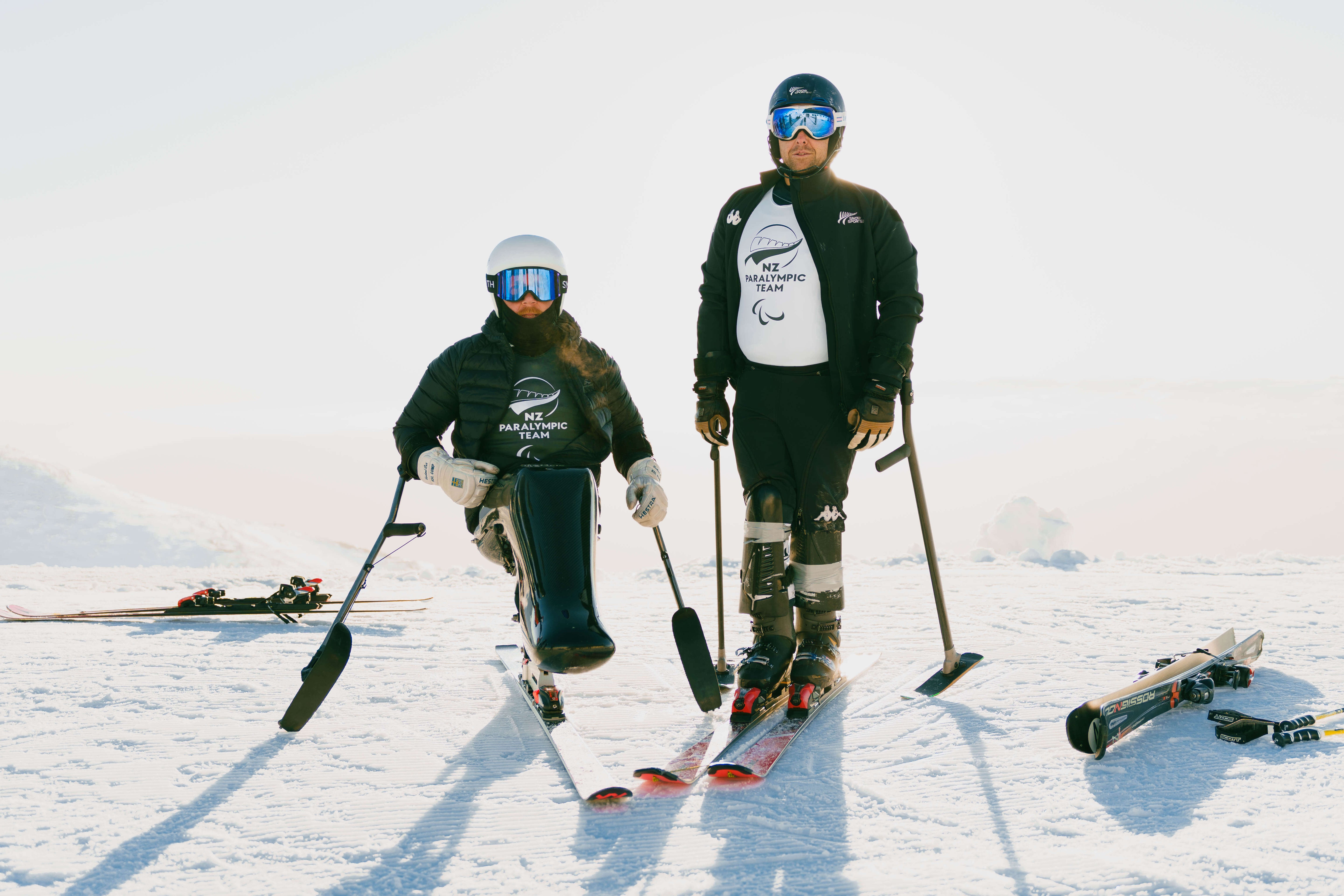
Power On Portraits.
When the world turns its eyes to the Milano Cortina Paralympic Winter Games , two Kiwi athletes will once again carry the silver fern with pride and determination. Adam Hall and Corey Peters are no strangers to the Paralympic stage — both have etched their names into New Zealand’s sporting history with performances defined by courage, resilience, and sheer willpower.
For Adam, a decorated Paralympic skier who has inspired generations with his trademark grit, and Corey, a sit-ski champion who has conquered some of the world’s most challenging courses, the road to Cortina is more than just about medals. It’s about proving what’s possible when you refuse to be defined by obstacles.

At mophie, our rally cry is Power On — and Adam and Corey embody that spirit in every way. Whether carving down icy slopes at top speed or pushing through the unseen battles behind the scenes, they show us that true power comes from perseverance, belief, and the pride of representing Aotearoa on the world stage.
As they prepare for Milano Cortina, we sat down with Adam and Corey to talk about their journey, the challenges they’ve faced, and what Power On means to them — and to all Kiwis who dare to chase their own mountains.
This is Power On Portraits with Adam Hall and Corey Peters.
On: Paralympics discipline.
Adam:
My discipline in Para alpine skiing is slalom. Slalom is the most technical event in Para alpine skiing where gates are technically anywhere from 9 to 12 meters down the hill. It is very unique because it is the most technical, demanding event that we have that showcases the technical talents of all the Para-athletes.

Corey:
My discipline is the men's sitting category. So effectively I am sitting in a sit ski while I am going down the mountain. What makes it unique is the speeds that we get up to and the G-Force that are acting on our bodies as we're going through the turns is very high. The speeds are getting up to about 115 kilometres per hour. (71.45 mph)

On: The attraction to the sport.
Adam:
What drew me to the sport of alpine skiing and to the mountains was having found a sport that was unique, different, and gave me the sense of freedom and independence. A sport and environment where I found something that I was able to excel at amongst my peers and go on to do really well.

Corey:
I think what drew me to the sport and skiing in general is probably the speeds and the adrenaline rush that you get. It's probably one of the more extreme Paralympic sports that you can get into purely because of the speeds that we get up to. So yeah, I mean, I don't think it was the cold that drew me to it, probably more the adrenaline rush.
On: Preparation leading up to the Milano Cortina Winter Games.
Adam:
To give you a typical idea of a training day in my sport, as we build up towards Milano, Cortina: It involves a lot of time on snow, a variation of time in the gym, a lot of time of planning behind the scenes work that nobody gets to see. Spending time with world-class resources that we are surrounded by from strength and conditioning coaches both on snow, off snow, nutrition, physio team doctors, full medical team sports physiologists, a number of resources behind the scenes that we have access to as world-class athletes to give us the best chance of performing to the best of our abilities on the top stage.
Corey:
I think a typical training day leading up to the Paralympic Games, there's probably a lot more intensity involved, obviously because you know that I guess the goal is nearing, it’s getting closer each day. But typically, we would get up early in the morning, travel up to the ski resort, do a couple of hours training in gates and travel back down off the hill. And then we would do recovery sessions or a light weight session in the gym. And then we would look at recovery. So, a lot of stretching, mobility, and I guess resting the body and preparation for the following day.
On: A life shaped by disability
Adam:
I was born with my disability, so in a lot of ways I don't know any different. But in saying that there are a number of challenges that happen day in, day out, week in, week out, whether we have a disability or not. Sure, perhaps I had to overcome a lot more obstacles than your average Joe Blogs, if you like, which has turned me into the person that I am today or the athlete (I am today). But in all honesty, I have known no different. Having grown up with my disability, being born with my disability is a lot different than having had an accident or having lived through something that has dramatically changed my life all of a sudden.
Corey:
I think my disability shaped the way I approach life and my sport in numerous ways, but I think in particular it's probably given me more drive to want to succeed and make something of my life.
Obviously, I had my life before my injury or my accident and my life and yeah, it's just that desire to make something of yourself and be successful and achieve great things on a world stage.
On: Resilience as an athlete
Adam:
Paralympic sport is about resilience. The spirit of the Paralympic games represents a lot of resilience as well, along with many other attributes. To me, resilience is about not just getting knocked down, but how you get back up and take your next steps forward. And ski racing has been a lot of times where resilience has had to come into play.

I can recall a time in my second campaign in 2010, the Winter Paralympics in Vancouver. After my first run, I was in the lead by just over two seconds and in my second run I crashed and had a fall. I had a decision to make then where I could simply stop, give up and not know what was possible or do what happened… my body seemed to go into autopilot after years of training (my body) and I got back up and I finished my second run, completing two runs to come away with a gold medal. One of the major highlights in my early career.
Corey:
I would say to define a particular moment that I've had to overcome and show resilience is probably the two shoulder dislocations that I've sustained while training and competing in my sport. The speeds I guess that we come up against obviously come with a great risk. They were years apart, but certainly a key moment that I've had to overcome and show resilience and work through that rehab in order to get back to the top level.
On: What Power On means personally.
Adam:
Power On for me means a number of things.
From a performance perspective, it means flicking that switch and getting ready for full gas in the start line. Also, for me it means full purpose and full intent.
Corey:
Power On to me means switch on - on a daily basis and try and get the most out of each day to pushing yourself and being able to push your own limits to achieve greatness, whether that be in life or in my chosen sport.

On: Finding inner power.
Adam:
I find my inner power when I feel like I'm low on power. I draw on my experiences where I have been through difficult times to help keep my power charged, to get me through any experience so I'm ready to attack, head on and break through whatever barriers that may come my way.
Corey:
The inner power for me is I feel like it's kind of innately in me… that desire to want to achieve, to want to do the best that I can. I feel like it's kind of within me and it's been ingrained in me and that's helped me overcome obstacles throughout my life, whether it's sustaining the spinal cord injury or competing in a Paralympic downhill race and achieving the gold medal.
On: Representing New Zealand.
Adam:
Statistically, not many people have this opportunity and have this chance to be selected to represent our country at such a high level. Representing New Zealand and the chance to represent our nation on the world stage is an honour and a privilege. It is only a small chance and a small opportunity that we as athletes get once every four years to showcase to you and the rest of the world what it is that we do every other day and every other season in between the games.
Corey:
For me, I guess it sounds a bit cliche, but obviously there's a lot of pride and honour in it. Not everybody gets that privilege to be able to compete for New Zealand. So, for me it's an honour and a privilege to be able to do so, and I love to do it to the best of my ability and give it 110%.
On: Goals for the games.
Adam:
As I build on my journey towards my sixth Paralympic Winter Games, I'm currently working towards getting medal number six and getting a medal at a third consecutive Winter Paralympic Games. That's what I'm currently working towards. And there's no hiding behind the fact that every athlete is after a gold medal. It's a very, very competitive sport, a very competitive discipline.

Corey:
My personal goal for Milano Cortina 2026 is to try and replicate my result in Beijing, to defend my Paralympic gold medal in the men's downhill and hopefully go one better in the Super G and come back with a double gold. Obviously, it's a massive task, but we've put in the hard work over the last few years and that would be a massive achievement and a massive goal ticked off for me to be able to do that.

On: The support from home.
Adam:
All I can say is thank you for your support! Please come on our journey. Follow our journey, be part of our journey as we build up towards the games and follow us as closely as you can. We feel your support. We feel everything back home in New Zealand, especially while we're on the road competing, building towards the games. And we appreciate it. We don't take your support for granted and we'll be doing everything that we possibly can to get the job done. Thank you for your support. Jump on the bus, come for the ride, and enjoy the journey as much as we will.
Corey:
To all the fans and supporters that are supporting us while we're competing in Milano Cortina, I'd just like to say a massive thank you for all your continued support that you've given us and the team as a whole and hopefully we can make you all proud.
Power On Adam & Corey! We’ll be cheering you every step of the way!
mophie is a proud team supporter of Paralympics New Zealand.
Follow the team's progress on socials: https://www.instagram.com/paralympicsnz March 6 - 15.

Share:
Powering Dane Henry. The Ambassador Interview.
Power On Portraits - Molly Picklum WSL Season Kick Off.